Sharing experience and knowledge - offering a range of training types
Training courses
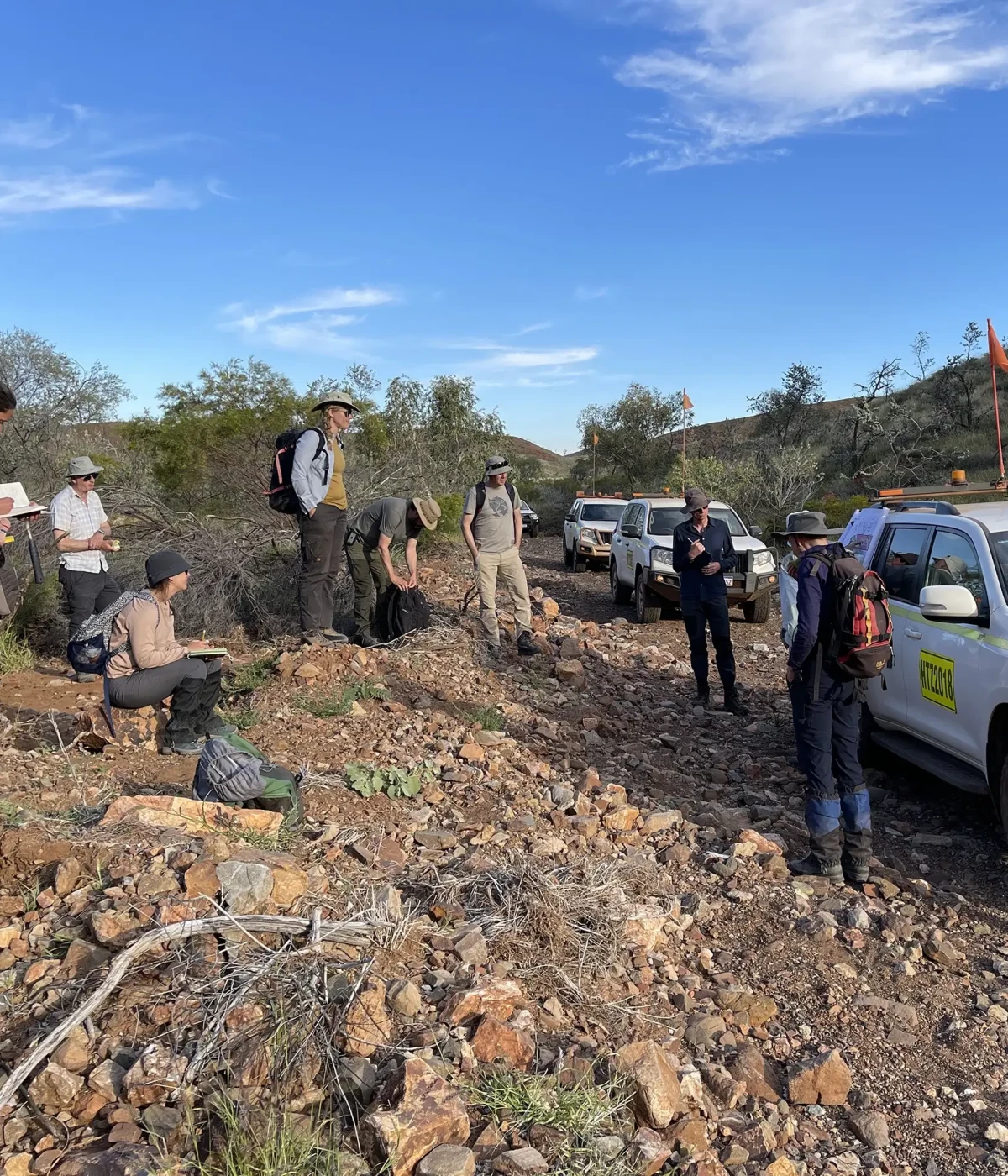
Courses are offered as stand-alone, or as part of consulting projects. Contents ranges from off-the-shelf to fully bespoke. From classroom courses to field mapping and logging structures in oriented core.
Providing theoretical and applied structural geology courses, translating data, concepts and modelling philosophy into constructing fit-for-purpose models, using software tools and techniques. Technology-transfer with emphasis on kinematic modelling software MoveTM.
Public and bespoke courses for junior exploration companies to mining houses, for oil and gas companies, geological surveys, and universities.
Explore our training courses
-
Applied structural geology – Principles and practicalities
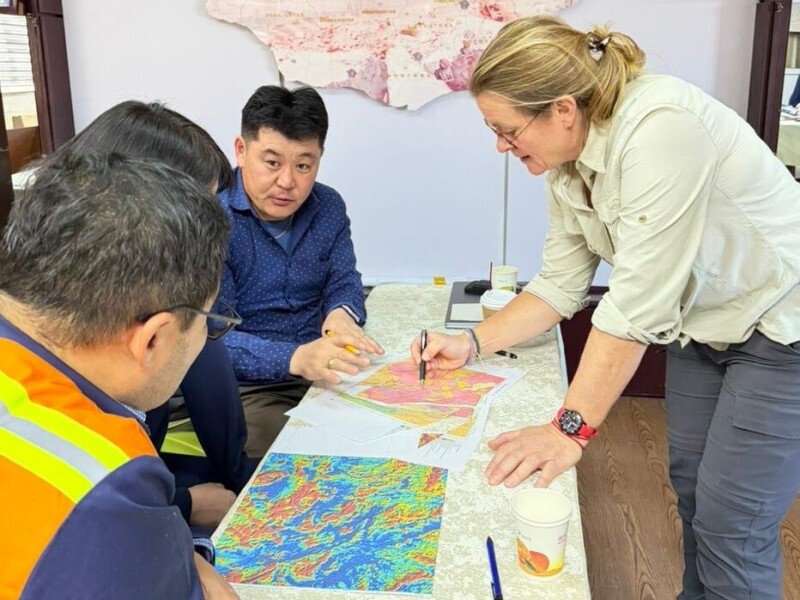
Principles and PracticalitiesThis 1 to 5-day taylored course provides an overview of the main structural geology subjects, and then lays out the key aspects of significance for systems of interest. How can structural geology best be applied? Be it for a petroleum system, or the structural-geological development of a fault framework hosting gold-mineralizing fluids, or for predicting the size and shape of fault blocks targeted for geothermal energy. This course is greatly appreciated by exploration and mining teams, alike.
-
How to identify inconsistency and minimize uncertainty in geological models
Move SuiteThis course is mostly delivered in the form of a single-client Technology Transfer, raising the level of team skills as part of an in-house project. Topics include data QC, data characterization using stereographic projection, constrained section construction including line-length balancing, and ensuring consistency with the geological maps and tectonic context of a particular project at hand.
Combined with ongoing mentoring, this course provides long time value.
-
3D kinematic analysis and jigsaw fit balancing for Cu porphyry systems
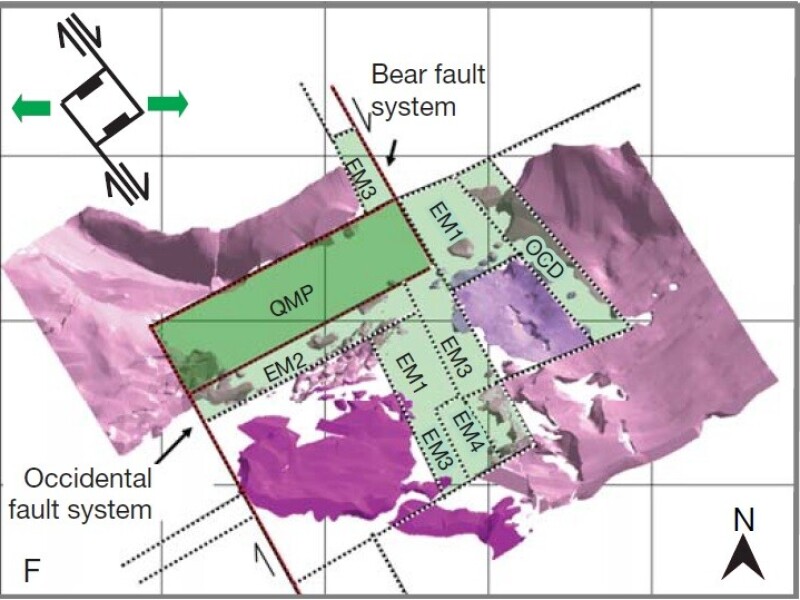
A case study - Bingham Canyon Cu porphyry systemAn advanced training course, either single or multi-client, or at academic level, concerns the Cu-Au system that relied on a significant component of fault-assisted emplacement of the porphyritic intrusions. This course addresses mapped fault patterns, 3D fault shapes and linkages, fault timing and kinematics. The analyses focus on developing an interpretation of the structural geological history that is consistent with the data and is geometrically valid. The course outlines techniques that minimize uncertainty in modelled frameworks, and optimizes prediction in areas without direct data (yet).
-
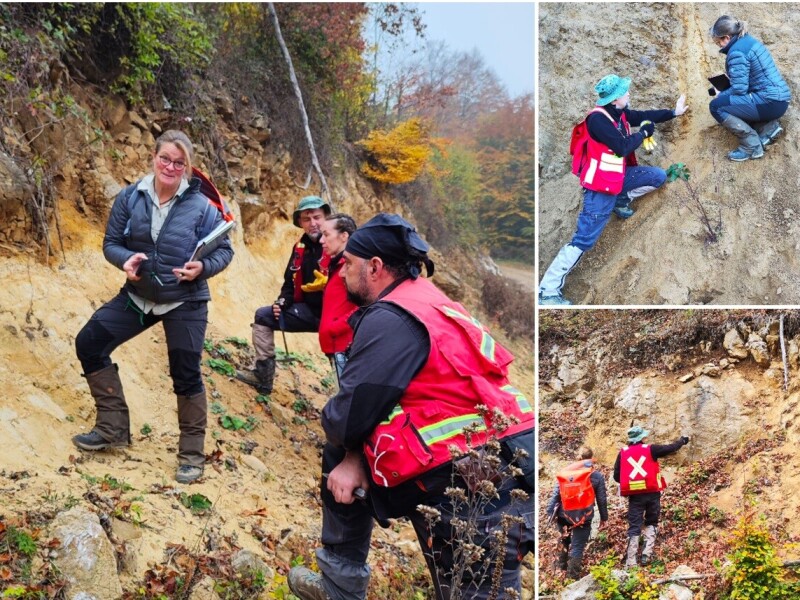
Digital field mapping of relevant structures using FieldMove-Clino
FieldMove-ClinoThis course has two objectives. First of all, to train your eyes and mind for conducting fit-for-purpose mapping, i.e. mapping geological features significant for the questions at hand, going into the field with a clear plan and optimized objective, and as such knowing - in advance - what the key observations are going to be. Secondly, you will learn and practice how to best set up your FieldMove-Clino app for efficient collection of oriented data, planar and linear, and how to export and condition the data for further interpretation. Partly a class room, but mostly a field-based course. Best when tailored to your commercial project. Also, much appreciated when added to academic mapping expeditions.
-
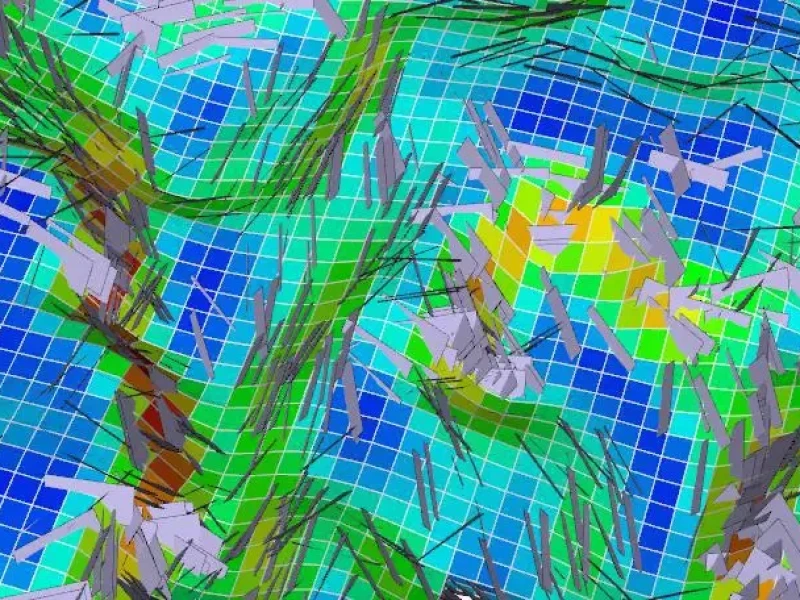
Modelling faults and discrete fracture networks (DFN) using the Move Suite
A case studyDFN modelling aims to characterize the subsurface for projects that either target the fractures or are concerned with the fault blocks in between. Modelling can be done in either data-poor and data-rich projects. Constraints may be limited to surface structures and theoretical extrapolation to depth, or may include detailed structural data logged in core, on bore-hole imagery, mapped in pit and trench outcrop, and interpreted as (near sub-) seismic discontinuities.
The training will illustrate why you need to go beyond the statistical approach, and why a thorough geological understanding of the area is required. Hence, the training is best set up as a workshop ensuring optimum use of team knowledge. Bespoke courses may include an element of field ground-truthing using analogue outcrop constraints.